Massive, devastating flooding swept through much of Florida’s east coast after days of relentless rain. Palm Bay, Malabar, Melbourne, Port St. Lucie and West Palm Beach were among the hardest-hit communities, with roads under water and people rescued from flooded cars and homes.
Because this was a rain event rather than a hurricane, many building owners and managers will assume their roof made it through. It may have. But rain like this tests something wind doesn’t: drainage.
Every roof is a system for moving water off a building. On a normal day, that system has plenty of slack. During several days like these, every weakness in it gets found, and some of what it finds won’t show up as a leak for weeks.
Why a Rain Event Is a Different Kind of Test
Hurricanes get the attention because wind damage is visible: lifted membrane, torn flashing, displaced equipment. A rain event like this one does its damage quietly, by overwhelming the path water is supposed to take.
Four things made this stretch of rain especially hard on roofs:
- Intensity. In the heaviest bursts, rain fell far faster than usual. That’s water arriving faster than many drains, scuppers and downspouts can carry it away.
- Duration. This wasn’t one storm. It was several days of repeated downpours. Roofs had little or no time to drain between rounds, so any water that couldn’t get off quickly was still there when the next round arrived.
- Saturated surroundings. The ground was already soaked, and the event came just days after king tides set non-hurricane flood records in parts of Florida. With storm sewers and site drainage full, water leaving the roof had nowhere to go. Downspouts backed up, splash blocks sat underwater, and leaders tied into underground piping could stop flowing.
- A sudden change after a dry stretch. Central Florida’s rainy season had actually ended with a rainfall deficit. Some roofs went from weeks of light rain, when debris quietly collects at drains, straight into a record deluge.
Wind damage tends to be obvious the day after. Drainage damage often isn’t, which is why it’s worth looking closely now.
How a Low-Slope Roof Is Supposed to Handle Water
A “flat” commercial roof isn’t really flat. It’s built with slope, often through tapered insulation and crickets, that directs water toward drainage points. Those drainage points come in two layers.
Primary drainage does the everyday work. That means interior roof drains, through-wall scuppers, or edge gutters feeding downspouts. It’s sized for a design rainfall rate set by code for the building’s location.
Secondary (overflow) drainage is the backup. Overflow drains or overflow scuppers sit slightly higher than the primary drains, so they only start working when water rises above normal levels. Their job is to keep water from building up on the roof if the primary system clogs or can’t keep up.
When both layers are clear, correctly sized and set at the right heights, a roof can handle a very heavy downpour. The trouble is that many roofs don’t meet all three conditions, and most owners don’t find out until rain like this arrives.
It’s also worth keeping the scale of this event in perspective. Roof drainage is typically sized for the heaviest hour of rain expected about once in 100 years. In the hardest-hit areas, this event went well beyond that. A roof that struggled there wasn’t necessarily badly designed. But it does mean the backup systems, overflow drainage and the roof structure itself, were likely asked to do real work, and that’s exactly where problems tend to hide.
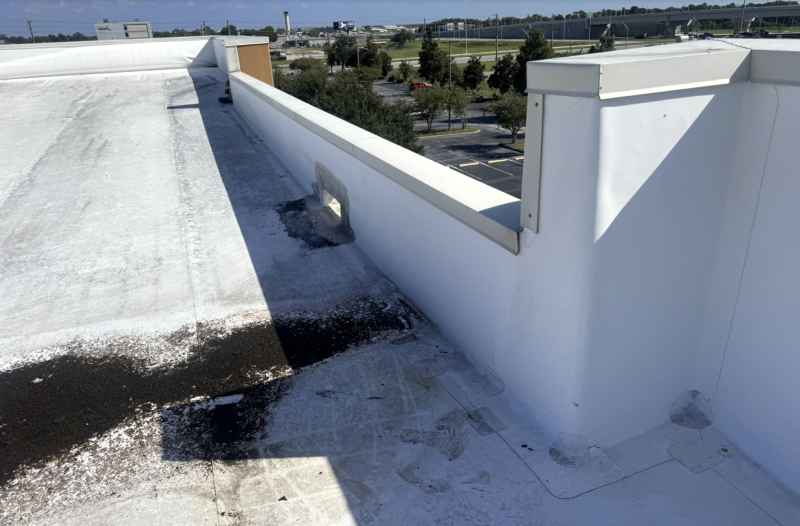
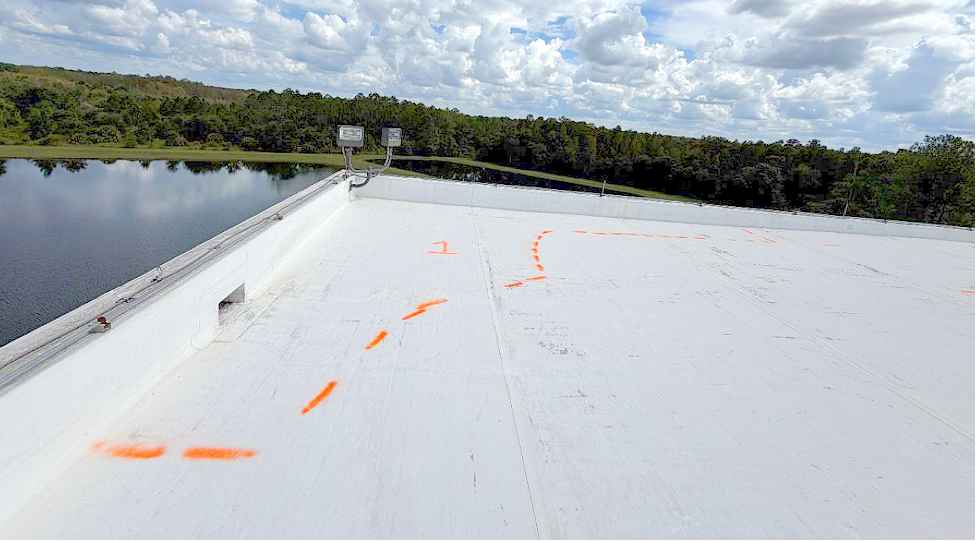
Through-wall scupper in a parapet wall with dark staining on the roof where water collected.
Where Drainage Fails When the Rain Won’t Stop
Extreme rain doesn’t create new weaknesses. It exposes the ones that were already there. These are the failure points we see most often after heavy rainfall.
Clogged or partially blocked drains
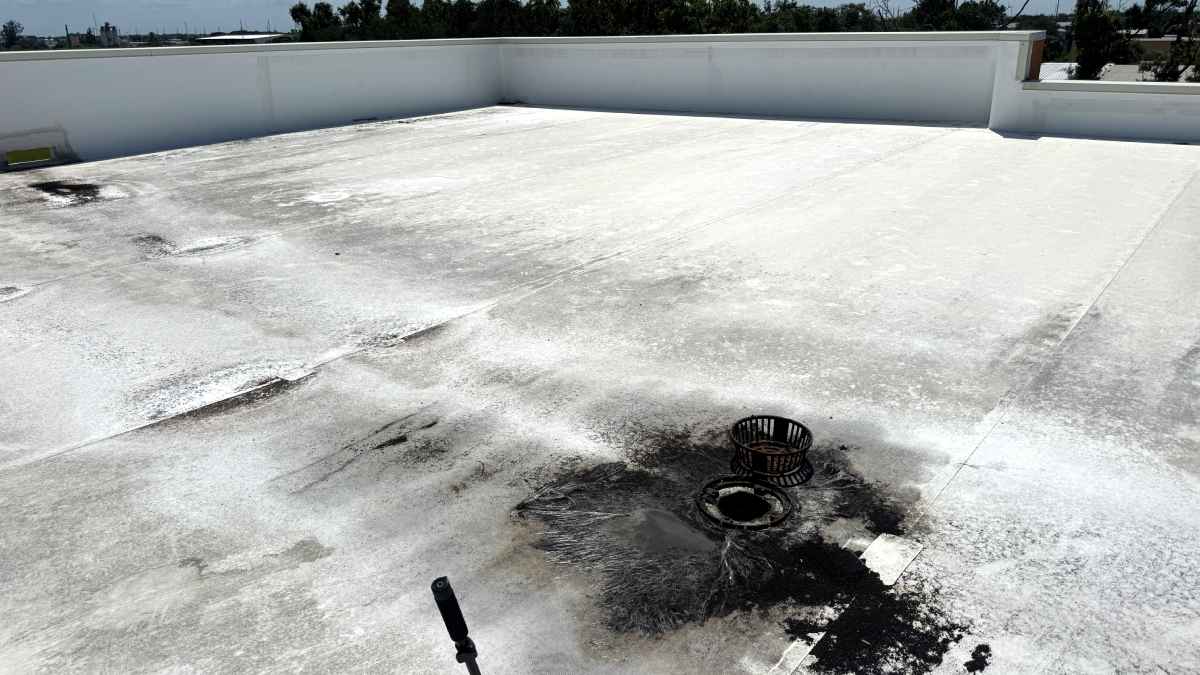
Leaves, bird nests, loose gravel, construction debris and even forgotten tools collect at drains. A strainer that’s half covered can cut a drain’s capacity dramatically. On an ordinary day, that may only mean a slow puddle. Over several days of heavy rain, it means water backing up across the roof, round after round.
Missing, blocked or mis-set overflow drainage
Overflow scuppers and drains are easy to forget because they rarely do anything. We regularly find them blocked by debris, partly covered by later roof layers, or set too high to activate before water reaches flashings and penetrations. On older buildings, they sometimes don’t exist at all.
Roof-overs and added layers that changed the water levels
Each time a roof is covered over or tapered insulation is added, the roof surface rises. If drains, sumps and scuppers weren’t adjusted to match, they can end up sitting above the surrounding roof. Water then pools around them instead of flowing in.
Ponding in low spots
Deflected decks, crushed insulation and settled areas create low spots that hold water. Ponding speeds up membrane aging, and during heavy rain these areas fill first and deepest.
Water backing up behind parapets
Parapet walls turn a roof into a basin. If water can’t get out fast enough, it rises up the base flashings, sometimes above the top of the flashing. That’s how water reaches seams, counterflashings and coping joints that were never meant to be underwater.
Gutters, downspouts and conductor heads
Undersized gutters, crushed or disconnected downspouts, and conductor heads packed with debris all overflow under heavy rain. The overflow often runs down the face of the building instead of away from it.
Where the roof meets the wall
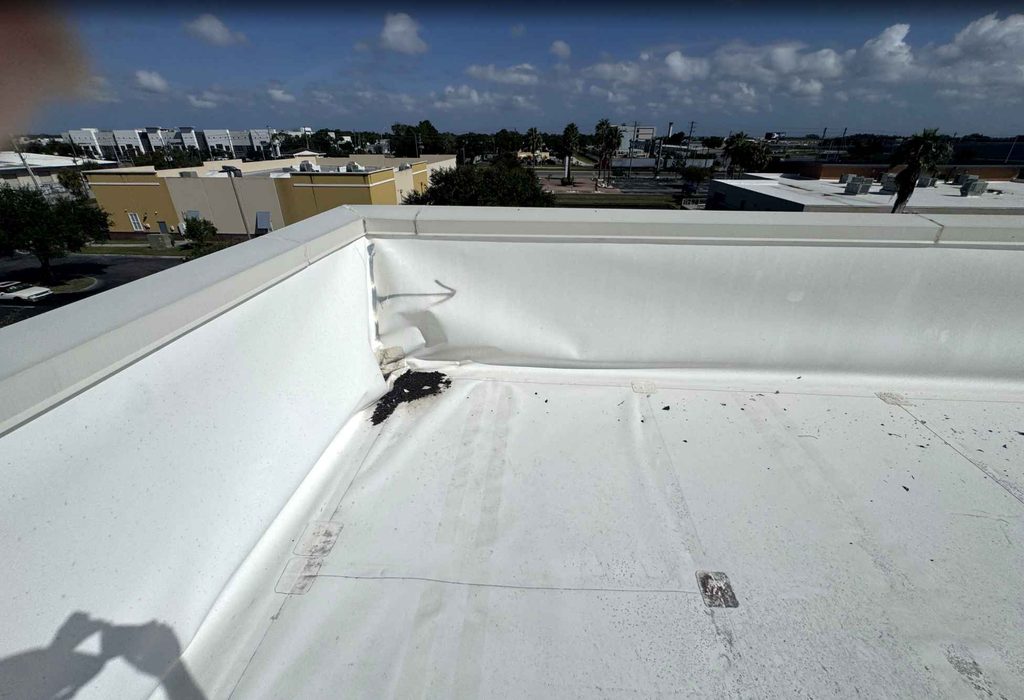
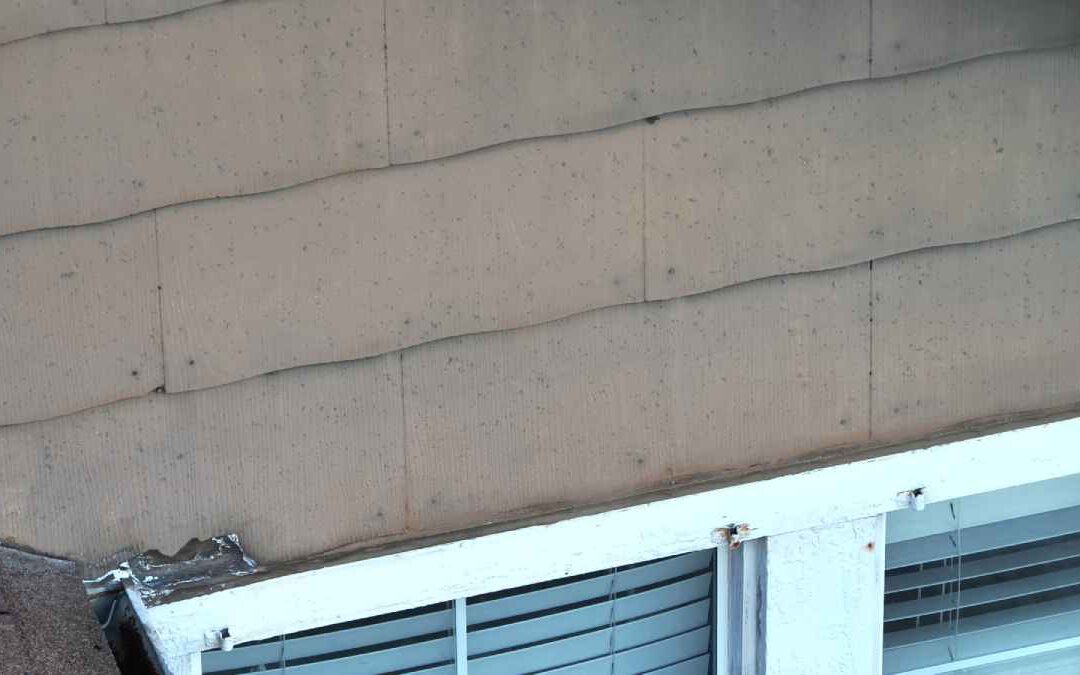
Wrinkled base flashing and debris at an inside parapet corner on a white single-ply roof.
When water stands against a wall, it finds openings at roof-to-wall transitions, window heads, through-wall flashings and facade joints. Many “roof leaks” after an event like this one actually start at these transitions, or at windows dealing with sustained wind-driven rain.
Don’t Forget the Weight
Water that can’t drain doesn’t just leak. It loads the structure. Every inch of standing water adds about 5.2 pounds per square foot.
| Water depth on roof | Added load |
| 1 inch | about 5.2 lb/sq ft |
| 2 inches | about 10.4 lb/sq ft |
| 4 inches | about 20.8 lb/sq ft |
| 6 inches | about 31.2 lb/sq ft |
As water collects, the deck deflects a little. That deflection makes a deeper low spot, which collects more water, which deflects the deck further. Engineers call this progressive ponding, and it’s a key reason codes require secondary drainage. Lightweight steel decks and older, long-span structures are the most vulnerable.
Multi-day rain makes this worse. When a roof can’t fully drain between downpours, the load from one round is still there when the next begins.
This isn’t only a theoretical risk. During an earlier heavy rain in Brevard County, a commercial facility in West Melbourne had a partial roof collapse, and the building was posted as unsafe for occupancy. The cause hasn’t been made public, but it’s a reminder that heavy rain can affect more than the roof covering.
If you saw deep standing water on a roof during the storm, or you notice new sagging, cracked ceiling finishes or doors that stick near the roof level, have a structural engineer take a look.
“No Leaks” Doesn’t Mean “No Water”
The most expensive damage from an event like this is often the damage nobody sees right away.
When water stands at a flashing, seam or penetration for hours or even days, as it did on many roofs during this event, some of it can work its way under the membrane. Once it’s there, roof insulation can act like a sponge. Water spreads sideways through the roof system, sometimes far from where it got in, and it may not drip into the building until the insulation is saturated or the water finds a path down.
That’s why leaks can show up days or weeks after the rain stops, sometimes on a perfectly dry day. By then, the connection to this storm isn’t obvious, and the wet area under the membrane may have grown.
Wet insulation also causes slower problems: it loses much of its insulating value, it can weaken the attachment of the roof system, and it can promote corrosion of fasteners and steel decks. None of that is visible from inside the building or from a quick walk across the roof.
What to Check in the Next Few Weeks
If your building was in the path of this flooding, a careful look now is far cheaper than chasing leaks later. Only qualified people should go on the roof, and nobody should walk on a roof that is still holding water or shows signs of sagging.
On the roof:
- Clear and inspect every primary drain, strainer and scupper. Note anything that was blocked and what was blocking it.
- Find every overflow drain and overflow scupper. Confirm each one is open, and check that it sits low enough to work before water reaches the flashings.
- Look for debris lines, dirt rings and watermarks. They show how high water rose and where it sat longest.
- Check base flashings, counterflashings and coping on parapet walls, especially anywhere the watermarks reached.
- Mark areas that still hold water 48 hours after the rain. Those are your ponding areas.
- Look for soft spots, blisters or membrane that feels spongy underfoot. These can signal water under the membrane.
Around and inside the building:
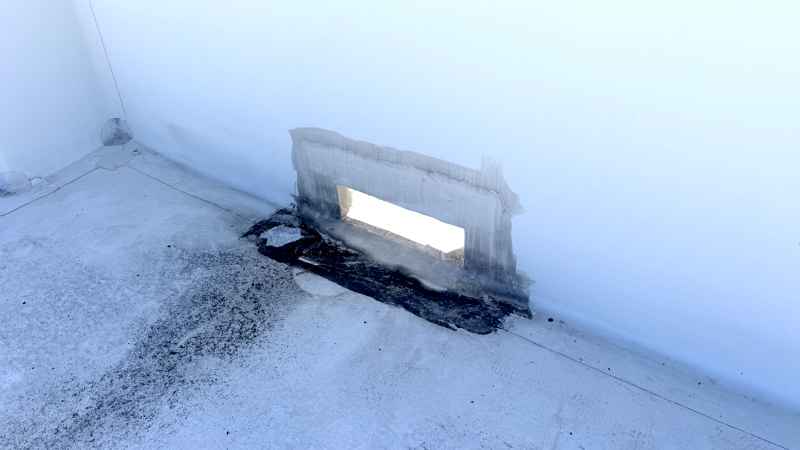
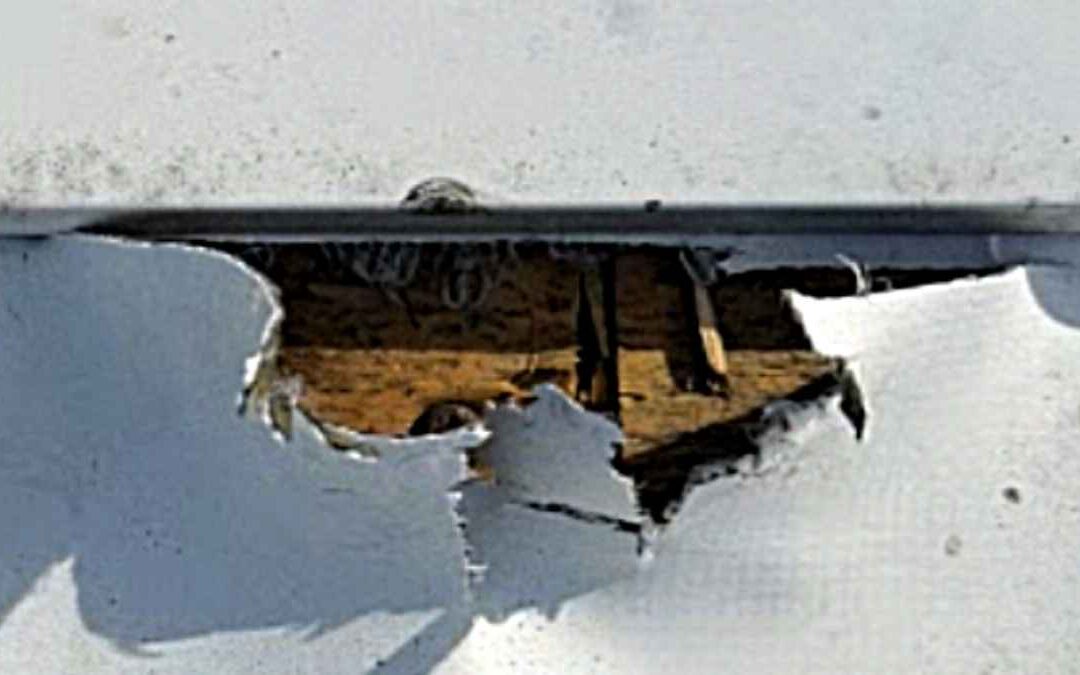
Close-up of a through-wall scupper with staining and patched membrane at the opening.
- Check gutters, downspouts and conductor heads for overflow staining, damage or disconnections.
- Make sure downspout discharge points and underground leaders are flowing again.
- Walk the top floor. Look for new ceiling stains, damp ceiling tiles, musty odors, or staining at window heads and exterior walls.
- Keep a list of any leaks that appear over the next several weeks, with dates, locations and weather conditions.
Document as you go. Take dated photos of drains, watermarks, ponding and any interior damage, and keep notes of what you found and what was cleared or repaired. If you think an insurance claim is possible, report it promptly and review your policy’s notice requirements. Good records made now are much more useful than reconstructions made months later.
When a visual check isn’t enough. If you’ve found high watermarks, long-standing ponding or new leaks, a visual inspection can’t tell you how far water has spread inside the roof system. Non-destructive moisture testing, such as infrared, capacitance or impedance scanning confirmed by core samples, can map wet areas before they turn into repair-or-replace decisions.
Free Resources to Help
These free downloads can help you work through the checks above and keep good records:
- Roof & Facade Drainage QC Checklist: a step-by-step way to inspect and document drains, scuppers, gutters and overflow paths. The best place to start after this event.
- Commercial Roof Walk-Through Checklist: a structured walk-through for flashings, seams, penetrations and general roof condition.
- A Guide to Low-Slope Roof Moisture & Leak Detection Testing: the strengths and trade-offs of the common methods for finding water inside a roof system.
- Severe Storm & Hurricane Preparedness for Low-Slope Roofs: use it to get drainage and the rest of the roof ready before the next big rain.
The rain has stopped, but the water it left behind may not be gone. A few hours spent on drains, overflows and watermarks now can tell you whether your roof handled it, or whether it’s quietly still dealing with it.
Sources